The U.S. Department of Education rules require NJIT to verify the presence of students in classes prior to the disbursement of financial aid. Students must be present at least once before aid can be disbursed. Click here for the Academic Engagement information.
Eligibility for most financial aid programs is determined on the basis of financial need and on several other factors. Basically, to receive aid from most programs, you must meet the following criteria:
You must demonstrate financial need (not a criterion for some scholarships and some loans)
Student Financial Aid Services (SFAS) constructs yearly cost-of-attendance (COA) budgets that include tuition, fees, housing and food (or living expenses), books, course materials, supplies, & equipment, transportation, and miscellaneous expenses. The COA varies according to enrollment level and state residency. As a financial aid applicant, you and your family have primary responsibility for contributing to the total cost of your education. The information that you and your family report on the FAFSA is used in a formula established by US Congress to determine your Student Aid Index (SAI). SAI is an eligibility index number that the financial aid office uses to determine how much federal aid student is eligible to receive.
Financial aid attempts to fill the gap between your SAI and the yearly COA. The difference between the SAI and the COA is defined as financial need. If you're eligible, you may be awarded financial aid through a combination of grants and scholarships (which you won't have to repay), loans (which you will have to repay), and work-study (part-time employment on or off campus). These combinations of awards are referred to as financial aid packages. Keep in mind that, because of the variation of the COA, financial aid packages will vary as well.
Total aid—including scholarships, grants, federal work-study, loans, and other educational resources (such as tuition remission and veteran's benefits)—cannot exceed the total COA, whether the student aid was administered through SFAS or some other source. In cases where a student receives funds from certain federal student-aid programs, total financial aid may not exceed his or her demonstrated financial need.
Students should submit their Free Application for Federal Student Aid (FAFSA) on October 1 but no later than February 15. Late FAFSA submissions can affect eligibility for some financial aid programs.
For most students, only a completed Free Application for Federal Student Aid (FAFSA) is necessary to receive an award offer. Students are notified via e-mail if Student Financial Aid Services (SFAS) needs additional documentation to process financial aid.
We recommend submitting outstanding financial aid requirements as soon as possible or within 14 days of the request. There will be a delay in award processing if documents are received late. Processing can take up to 30 days after submission.
New/transfer students who submitted a FAFSA and all required documentation will begin to receive award offer notifications around the middle of January/February each year. Students with outstanding documentation requests may receive an unofficial estimated award offer that is subject to change until all requirements are satisfied. For all major deadlines, please visit the deadlines to watch page.
If a student or family member recently lost a job or experienced financial hardship due to death, divorce, or unexpected medical expenses, they may submit an Appeal for Income Reduction. Requests do not guarantee an increase in aid. You can download the application here.
Students apply for federal student loans by completing the Free Application for Federal Student Aid (FAFSA) each academic year. Once we receive your FAFSA, we will offer the federal student loans. You will need to accept the loans at http://my.njit.edu.
Students can accept/decline/reduce any federal loan offered to them through the online award offer. Students can access the award offer through their Highlander Pipeline at http://my.njit.edu.
Students can submit a Financial Aid Adjustment form to submit loan adjustment requests.
The deadline for accepting federal loans in any given semester is generally about two weeks before the end of that semester. Tuition and fee billing due dates are prior to the due dates to accept loans.
The difference between Subsidized and Unsubsidized loans is the accrual of interest. Subsidized loans will NOT accrue interest while the student remains enrolled in school at least half-time (6 or more credit hours for undergraduate students). Interest on Unsubsidized loans will accrue from the date of disbursement. More detailed information about both Subsidized and Unsubsidized loans can be found here.
Financial aid disburses about 14 days into the semester as long as Verification of Presence is received from your professor. If you are selected for verification, you may need to provide additional documentation before your aid can be disbursed. Disbursement can be delayed depending on when SFAS receives the requested documents. Disbursement dates and other important dates and deadlines can be found on the deadlines to watch section of our website. After the initial disbursement of financial aid, additional disbursements occur regularly throughout the semester.
Pell Grant is adjusted if students enroll part-time. Loans, work-study and NJIT aid may be adjusted if the reduced enrollment also reduces a student’s financial need. Students must enroll at least half time to receive federal student loans and Tuition Aid Grant (TAG) requires students to be enrolled full time.
Yes. Please review Scholarship Policies for awarding and adjustment of scholarships.
Financial Aid Next Steps Checklist
- New Admitted students please see the Checklist for your next steps
FAFSA Information
Financial Aid Awards
Useful Information
Contact Us!
Helpful Videos
Navigate Financial Aid DashboardLearn how to navigate Financial Aid dashboard and review your awards.
| Accept Financial Aid AwardsLearn how to accept your Financial Aid Award on Pipeline.
| Create Student Forms AccountLearn how to create your Student Forms Account to submit documents.
|
Complete Affidavit on Student | Federal Loan Adjustment | Special Circumstance AppealComplete special circumstance appeal.
|
Student Aid Index (SAI): SAI is an eligibility index number that the financial aid office uses to determine how much federal aid student is eligible to receive. This number results from the information that students provide on the FAFSA® form. The SAI is not the amount of money a family will have to pay for college or the amount of federal student aid the student will receive. A negative SAI indicates the student has a higher financial need. Learn how the SAI is calculated. NJIT will determine your financial need by subtracting your SAI from the cost of attendance.
Financial Aid Package: The total amount of financial aid (federal and nonfederal) a student is offered by a college or career school. The school's financial aid staff combines various forms of aid into a “package” to help meet a student’s education costs.
Financial Need: The difference between the cost of attendance (COA) at a school and your Student Aid Index (SAI). While COA varies from school to school, your SAI does not change based on the school you attend.
Adjusted Gross Income (AGI): Your or your family's wages, salaries, interest, dividends, etc., minus allowable deductions as reported on a federal tax return
Cost of Attendance (COA): The total amount it will cost you to go to school—usually stated as a yearly figure. COA includes tuition and fees; on-campus housing and food (or a housing and food allowance for off-campus students); and allowances for books, course materials, supplies & equipment, transportation, federal loan fees, and dependent care. It also includes personal expenses; costs related to a disability; and reasonable costs for eligible study-abroad programs. For students attending less than half-time, the COA includes tuition and fees and an allowance for books, supplies, transportation, and dependent care expenses, and can also include housing and food for up to three semesters or the equivalent at the institution. But no more than two of those semesters, or the equivalent, may be consecutive. Contact the financial aid administrator at the school you’re planning to attend if you have any unusual expenses that might affect your COA.
Direct Loan: A federal student loan, made through the William D. Ford Federal Direct Loan Program, for which eligible students and parents borrow directly from the U.S. Department of Education at participating schools. Direct Subsidized Loans, Direct Unsubsidized Loans, Direct PLUS Loans and Direct Consolidation Loans are types of Direct Loans.
Direct PLUS Loan: A loan made by the U.S. Department of Education to graduate or professional students and parents of dependent undergraduate students for which the borrower is fully responsible for paying the interest regardless of the loan status.
Disbursement (disburse or disbursed): Payment of the loan funds to the borrower by the school. Students generally receive their federal student loan in two or more disbursements
Federal Pell Grant: A federal grant for undergraduate students with financial need.
Federal Perkins Loan: A federal student loan, made by the recipient's school, for undergraduate and graduate students who demonstrate financial need.
Federal School Code: An identifier that the U.S. Department of Education assigns to each college or career school that participates in the federal student aid programs. In order to send your FAFSA information to a school, you must list the school's Federal School Code on your application. A list of Federal School Codes is available in the FAFSA.
Federal Student Aid ID: FSA ID stands for Federal Student Aid ID. You can use an FSA ID to access personal information or electronically sign on various Department of Education (ED) websites. To apply for one go to FSA ID.
Merit-based: Based on a student's skill or ability. Example: A merit-based scholarship might be awarded based on a student's high grades. The scholarship awards may be reduced if a combination of grants and scholarships exceeds the tuition and tuition-related charges on the student bill.
Private Loan: Nonfederal loan made by a lender such as a bank, credit union, state agency, or school.
FAFSA Submission Summary (FSS): The FAFSA Submission Summary is a paper or electronic document from the U.S. Department of Education’s office of Federal Student Aid that lists answers to the questions on the student’s FAFSA form and gives basic estimates about the student’s eligibility for federal student aid. It is not a financial aid offer.
If the student provided a valid email address on their FAFSA form, they’ll receive an email with instructions on how to access an online copy of their FAFSA Submission Summary.
The student can view or print their FAFSA Submission Summary by:
- Logging in to StudentAid.gov using their FSA ID (account username and password);
- Navigating to the account Dashboard;
- Selecting their processed FAFSA submission from the “My Activity” page, which will bring them to the Status Center “Details” page; and
- Selecting “View FAFSA Submission Summary.”
Verification: The process your school uses to confirm the data reported on your FAFSA. Your school has the authority to contact you for documentation that supports income and other information that you reported.
Tuiton-based scholarship: A scholarship designated to only pay tuition and if another award exists on the package that duplicates this benefit, one of the awards will be reduced.
Income Reduction Appeal: An appeal a family makes requesting for the Financial Aid Office to consider their income losses so that the family’s strength is measured using recent information. The process takes time and requires supporting documentation. Please see a Financial Aid Advisor about this.
Summer Pell: A new regulation was passed that allows pell recipients who have used their regular 100% award in the Fall and Spring to benefit from an additional grant during the summer so long as they are making academic progress and registered for at least 6 credits.
Student Employment: A job opportunity on campus to build a student’s leader skills and resume. The jobs varies as well as the hourly rate. If you receive Federal Work-Study, the earnings from this source is not counted against you on the following FAFSA. However, if you use other sources of work, it will be counted as income on the FAFSA.
Loan grace period: The 6-month period after graduation or when a student falls below half-time enrollment status where the loan is pending. After the 6-month grace period ends, the loan will fall in repayment.
Deferment: The period where the loan payment is deferred and depending on the type of the loan interest may accrue. Deferment is provided when a student remains in school for at least half-time enrollment status.
Loan Default: A status where a loan was not repaid according to the loan terms and conditions. When in default, students may not receive federal aid and must make six consecutive payments to have this status removed.
Forbearance: A status where the loan is temporarily deferred (generally a year) due to financial hardship. The borrower reaches out to the lender/servicer to request this status but keep in mind the interest continue to accrue during this status.
As a financial aid recipient, you have the following rights:
- Access to complete information regarding fees, payment and refund policies.
- Confidentiality of all personal and family financial information.
- Reconsideration of aid eligibility if you or your family’s situation warrants it through an appeal to SFAS.
- Rights under Family Educational Rights and Privacy Act (FERPA) law which protects the privacy of your education records. If you want to allow SFAS to discuss specific details of your record with any person, including your parent, you must complete the Information Release Consent Form.
As an aid recipient, it is your responsibility to do the following:
- Advise SFAS of any additional aid received that is not indicated on your Financial Aid Financing Plan Offer notification.
- Inform SFAS if you expect to withdraw from the university.
- Follow application filing deadlines and submit to SFAS all required documentation for verification of financial and other information pertaining to your application within 14 days of the request.
- Give permission to SFAS to relay pertinent financial, academic and other information to donors of aid upon request.
- Maintain Satisfactory Academic Progress (SAP) for financial aid.
- Comply with the rules governing the types of assistance that you receive.
About 92 percent of our students receive financial assistance, and NJIT has awarded over $100 million in need-based, merit-based financial aid and student employment. Paying for college tuition can be a daunting task, but the Office of Student Financial Aid Services is here to help guide you through the process.
TYPICAL SOURCES OF TUITION PAYMENTS
- Financial Aid (grants and loans)
- Scholarships
- Parent Contribution
NET PRICE CALCULATOR
-
Estimate the cost of attendance through this interactive tool: njit.studentaidcalculator.com
Cost of Attendance
- Student Aid Index
= Financial Need
NEED-BASED AID
-
To be eligible for federal and state grants, student loans and work-study you must complete and submit a Free Application for Federal Student Aid (FAFSA). njit.edu/how-apply-financial-aid
FEDERAL AID
-
For federal grants and loans complete the FAFSA. The application opens on October 1. To maximize your aid eligibility, complete your FAFSA by the February 15 deadline.
NJ STATE AID
-
HESAA (Higher Education Student Assistance Authority)
New Jersey residents may be eligible for state grants. Students must complete their FAFSA and submit all required documents by the state published deadlines through your NJFAMS account. -
NJFAMS
Please make sure the student has created an NJFAMS account. NJFAMS is the student portal for HESAA which allows students to monitor their to-do checklist from HESAA and submit all requested documents for verification.
SCHOLARSHIPS
-
INSTITUTIONAL SCHOLARSHIPS
NJIT awards merit-based scholarships of varying amounts to admitted students.
-
SCHOLARSHIP UNIVERSE
With Scholarship Universe, an online portal to apply for scholarships, students are automatically matched for eligible scholarships just by creating a profile in Scholarship Universe
OTHER LOANS
-
After students have received the maximum of their federal loans and still have financial need, parents can apply for a Parent Plus or private loan. These loans require a credit check for eligibility.
PAYMENT PLANS
-
NJIT offers a monthly payment plan that allows students and parents to spread their tuition payments over half of the calendar year. Students must enroll in the plan prior to the posted payment deadline for the semester.
HIGHLANDER PIPELINE
-
Highlander Pipeline is available at my.njit.edu. To access Highlander Pipeline, use your students University Computing ID (UCID) and password.
-
Login regularly for updates on Financial Aid, Billing and campus communications.
-
If you would like to pay your child’s bill, please follow the steps below:
- Student needs to login to MyNJIT portal.
- In the Student Account Card, click on "Student Account & Payment Portal" link and hit Continue.
- In the My Profile Setup section, select Authorized Users.
- Select Add Authorized Users and input the necessary information.
Once you are added as an authorized user, this will allow you to electronically access and pay the bill. This authorization does not entitle you to access to any other student records. A FERPA release is required for all other access.
Students may borrow private student loans if they have received the maximum in their Federal Direct Loans. Please note that once you have completed the loan application from the lender, approved loans will take up to 15 business days or more for processing. To apply for a private student loan, click the following link: http://beta.elmselect.com/link/query?schoolid=356
Who can Borrow?
- Students (and parents) who are U.S. Citizens or eligible non-citizens
- International students are eligible with a creditworthy cosigner (who must be a citizen or permanent resident) and appropriate U.S. Citizenship and Immigration Service documentation.
- Non-matriculated students, only in special cases**
Eligibility
Eligibility criteria varies by the lender. Student must check the eligibility criteria with the lender before they apply. Some criteria that affects private loans is:
- Citizenship status
- Enrollment Status (Half-time or less than half-time)
- FAFSA completion
- Matriculation (accepted in a degree-granting program)
- Past balances (all lenders do not allow it)
- Satisfactory Academic Progress (SAP)
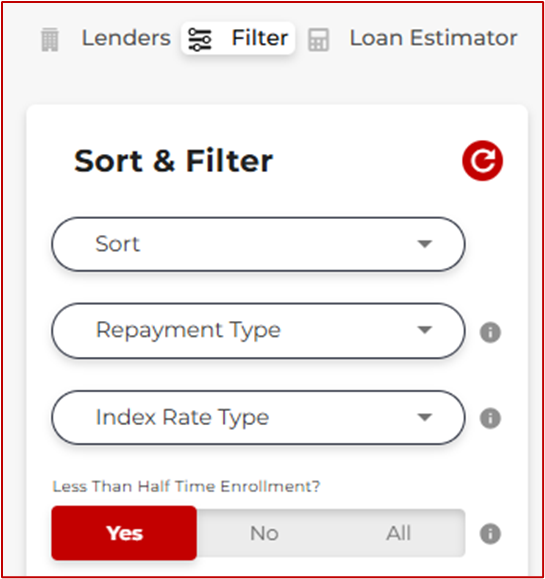
You can filter lenders using specific criteria. For example, if you need a lender that permits loans for students enrolled less than half-time, select the “Less Than Half-Time Enrollment” filter. You will first select your program (e.g., Undergraduate) and then click “View Loans" and then apply the filter.
Apply for Federal Financial Aid
We highly recommend you complete the Free Application for Federal Student Aid (FAFSA) and apply for any student financial aid for which you are eligible. Private loans should only be considered after state and federal sources of financial aid have been utilized. Undergraduate dependent students may have their parent review the Federal Direct Parent PLUS loan information, before opting for a private loan.
Private Student Loan General Information
Students and parents must contact the lender directly for specific terms and conditions of the loans. We are listing some general information for your reference:
- You may borrow up to the cost of attendance minus any other financial aid received. However, some lenders may have a limit to the amount that you can borrow to help with loan indebtedness.
- The interest rate on the private student loan varies by lender and can depend on the creditworthiness of the student and their co-signer.
- Repayment on private loan will begin after you graduate or cease be enrolled at least half-time.
- Typically, you have 10 years to pay the loan back; however, repayment terms vary by lender.
- There are no prepayment penalties so you can repay the loan earlier if you wish.
- To apply for a Private Student Loan, you must apply directly with the lender of your choice. You can find a list of lenders by visiting ELM Select which allows students and parents to search for and compare private loan options.
- Once you have made a decision you will be linked directly to the lender’s website to begin the loan application process.
- Private student loans are the financial responsibility of the student, not the co-signer, however, the co-signer is liable for loan repayment should the student fail to make monthly payments.
Keep in mind, a private loan is an agreement between the borrower and the lender. The borrower is responsible for carefully managing his/her educational loans. Many lenders offer online account management tools to allow the borrower to check their loan status, view disbursement information, and monitor loan balances.
**The federal government requires that you be officially accepted and enrolled in a degree-granting program (i.e., "matriculated") in order to receive financial aid (such as a Federal Direct Loan); however, some private lending institutions do not require matriculation for loan eligibility.
We've got everything you need to complete your application packet quickly. If you don't have the free Adobe Reader, download it now to view and print the PDF forms below.
You can determine which forms you still need to submit by logging on to the Highlander Pipeline at my.njit.edu and follow these steps to access your Self-Service Financial Aid Page:
- Claim your UCID (If not already done so).
- Log in to the Financial Aid Dashboard.
- Select the aid year from the drop-down menu.
- Go to the Home tab.
- Review the Student Requirements section for any outstanding items.
If you have already completed the required documentation, please continue to monitor your email and student portal to ensure no additional information is requested.
How to upload Verification Documents
To submit your verification documents, you will need to create an account for the document portal, if not created last year. For instructions see, Create My Document Portal Account.
Please note that at times we may request additional documentation and/or clarification after you have submitted the requested document. Just because you submitted the items, does not mean the verification process has been finalized. Federal regulations require schools to resolve all discrepancies that arise with the student’s paperwork compared to the data reported on the Free Application for Federal Student Aid (FAFSA).
Non-Award Year Specific Forms
NJ Tuition Benefits Non-Participation
NJ Tuition Benefit Agreement Form
NJIT Consortium Agreement
Private Loan Adjustment Request (Non-FAFSA Students and International Students)
Instructions
NJIT’s FAFSA filing priority deadline is February 15, but you can continue to file your FAFSA after the priority deadline and submit any required documentation after April 15; however, there are specific deadlines associated with each student aid program. If you apply late, you risk the inability to receive student aid from some programs. In addition to the processed FAFSA, SFAS must receive all requested documentation 30 days before the end of the semester or award period. This deadline allows processing and authorization of disbursements within timeframes defined by regulations pertaining to federal and state aid programs. Failure to apply or to submit required documentation by the indicated deadlines may result in a loss of financial aid eligibility for all student aid programs.
January
- SAP appeals for the spring semester (currently enrolled students only) are submitted to the Financial Aid Satisfactory Academic Progress Committee by January 11 (subject to change).
February
- FAFSA priority filing deadline for upcoming academic year is March 1. To apply for financial aid at NJIT, you must include NJIT’s institutional code, 002621, in the college choice section of the FAFSA.
- Summer Financial Aid applications available online under forms.
March
- Tax forms and any other requested information is submitted to SFAS as soon as possible but no later than March 15 for the forthcoming academic year.
April
- Student loan borrowers graduating in spring complete loan Exit Counseling.
- FAFSA for prior-year NJ TAG recipients due by April 15.
May
- Admission tuition deposits due May 1.
- Returning student records reviewed for Satisfactory Academic Progress (SAP) after spring semester grades get posted.
- Summer Financial Aid applications for Summer I due by May 8 (subject to change each year).
June
- Summer Financial Aid applications for Summer II are due June 15 (subject to change each year).
- SAP appeals for continuing students for summer semester are submitted to the Financial Aid Satisfactory Academic Progress Committee by June 15 (subject to change).
- Returning students Financial Aid Packaging begins for those registered for the following fall semester.
- Scholarship renewal for prior year recipients are packaged and sent if scholarship requirements are met.
- Students with a previous scholarship with insufficient available funds due to market conditions are sent a notification of such for planning.
- New students attend online orientation sessions.
- New student loan borrowers complete loan Entrance Counseling and sign Master Promissory Note.
July
- New students must complete mandatory academic advising sessions.
- Undergraduate scholarship applications due by July 10.
- Bills are sent in the last week of July.
August/September
- Student employees complete Student Employment/FWS contracts and I-9 forms.
- SAP appeals for continuing students for fall/spring semesters are submitted to the Financial Aid Satisfactory Academic Progress Committee by August 10 (subject to change).
- First time FAFSA applications must be received by the Federal Processor for NJ TAG eligibility by September 15.
October
- FAFSA available for filing (on October 1).
- Student Aid Reports (SARs) and Student Eligibility Notices (SENs) (the latter for only NJ residents) start arriving in the mail; be sure NJIT is listed as first college choice (school code 002621) on the SAR and SEN.
- Applications for Admission to Graduate Study are received by October 15 to receive full consideration for spring-semester graduate scholarships.
November
- Student loan borrowers graduating at the end of the fall semester complete loan Exit Counseling.
- Tuition bills sent to students registered for the spring semester.
December
- Student Financial Aid Services begins to notify incoming freshmen of scholarships.
- Need-based packaging begins for freshman and transfer students.
- Applications for Admission to Graduate Study are received by December 15 in order to receive full consideration for fall-semester graduate scholarships.