Add a header here if needed
text here if needed
NEWS
EVENTS
| Check Back Soon! |
| Affiliate Member Brownfield Success Stories | Location |
| Middlesex Logistics Center (SESI) | Edison, NJ |
| NJ ISRA Project (SESI) | Passaic, NJ |
| BridgePort I Logistics Center (SESI) | Perth Amboy, NJ |
| Carteret Logistics Center (SESI) | Carteret, NJ |
| 1510 Broadway (SESI) | Brooklyn, NY |
| iPark Edgewater, Brownfield Redevelopment (GZA) | Edgewater, NJ |
| Preferred Freezer Brownfield Redevelopment (GZA) | Elizabeth & Linden, NJ |
| Brownfield Success Stories | Location |
| Kearny Landfill Hartz Mountain Industries | Kearny, NJ |
| Hutchison Worldwide | Trenton, NJ |
| Town Center at Englewood | Englewood, NJ |
| Avenell Arts Village | Woodbridge, NJ |
| Clifton Main Mews | Clifton, NJ |
| PSE&G Pennsauken Brownfield Solar Farm | Pennsauken, NJ |
| Date | Event | Materials |
|---|---|---|
| 6/26/2023 | NJEDA's Brownfield Planning and Assessment Services Program | Presentation |
| 4/5/2022 | Mapping For Success: Using GIS & Remote Sensing to Inventory & Prioritize Your Brownfields | Presentation |
| 12/14/2021 | Refuel Your Community: Redeveloping Gas Stations into Community Assets Webinar | Presentation |
| 12/01/2021 | Funding New Jersey Brownfields Webinar | Presentation |
| 09/28/2021 | Brownfields Learning Lab Hosted by the NJ Highlands Council | Presentation |
| 09/15/2021 | Catching Some Rays: Solar on Brownfields Webinar | Presentation |
| 01/14/2021 | NJEDA Brownfield Loan Program | Presentation |
| 10/26/2020 | Transforming Brownfields: A Path Towards Environmental and Social Justice | Presentation |
| Date | Event | Materials |
|---|---|---|
| 6/26/2023 | NJEDA's Brownfield Planning and Assessment Services Program | Webinar Recording |
| 6/29/2022 | Redeveloping for Resilience: Transforming Brownfields for Community Resilience to Climate Change | Webinar Recording |
| 4/5/2022 | Mapping For Success: Using GIS & Remote Sensing to Inventory & Prioritize Your Brownfields | Webinar Recording |
| 12/14/2021 | Refuel Your Community: Redeveloping Gas Stations into Community Assets Webinar | Webinar Recording |
| 12/01/2021 | Funding New Jersey Brownfields Webinar | Webinar Recording |
| 09/28/2021 | Brownfields Learning Lab Hosted by the NJ Highlands Council | Event Recording |
| 09/15/2021 | Catching Some Rays: Solar on Brownfields Webinar | Webinar Recording |
| 01/27/2021 | Brownfields and Opportunity Zones: How To Prepare For Investment | Webinar Recording |
| 01/14/2021 | NJEDA Brownfield Loan Program | Webinar Recording |
| 12/2/2020 | ANJEC Brownfield Basics Learning Lab | Webinar Recording |
| 11/24/2020 | It Takes a Village: The Importance of Partners, Stakeholders, and Community Engagement in Brownfields Redevelopments | Webinar Recording |
| 11/12/2020 | Show Me the Money - Brownfields Funding | Webinar Recording |
| 11/5/2020 | Brownfield Basics | Webinar Recording |
| 10/26/2020 | Transforming Brownfields: A Path Towards Environmental and Social Justice | Webinar Recording |
Celebrating the 20th Anniversary of U.S. EPA's Brownfields Program: Looking Back, Moving Forward
What are Brownfields?
Redevelopment for Resiliency-Transforming Brownfield Sites | Colette Santasieri | TEDxNJIT
Bioremediation
The Key to Brownfields Financing
Before You Buy
Why is Liability Protection Important?
Does Liability Insurance Mean I Can’t Be Sued?
Who Else is Concerned with Liability Protection?
What is the Difference Between Federal and State Liability Requirements?
Spicket River Greenway
Pittsburgh’s Brownfield Success
Phoenix Park to Take Place of Brownfield in Camden
Philadelphia Wholesale Produce Market
Forgotten No More – Gray’s Ferry Brownfields
Philadelphia Navy Yard
New York’s High Line Park
New York’s High Line Park Section 2
Cramer Hill Waterfront Park
Greensgrow Philadelphia Project Overview
Greensgrow Farms Philadelphia- Cooking Channel
Down on the Urban Farm
Success Stories
For a collection of brownfields success stories follow this LINK.
Topical Brownfields Guidance & Tools
-
New Jersey Brownfield Development Grant Application Supporting Resources - Communities in New Jersey interested in applying for brownfield development grants can use the following resources to help you identify potential brownfield sites of interest, find property information, build a steering committee to guide redevelopment, and determine how redevelopment will benefit the community.
-
New Jersey Brownfields Inventory Mapping Layer - In collaboration with the Department of Community Affairs and the New Jersey Economic Development Authority, the Department of Environmental Protection has enhanced its Geographic Information System (GIS) mapping application, creating a Brownfields Inventory mapping layer that makes valuable information about brownfields sites easily accessible, helping investors, developers, community leaders, Licensed Site Remediation Professionals (LSRPs), and the public identify brownfields with redevelopment potential.
-
PEER: Platform for Exploring Environmental Records - Community Lattice has developed a portal available to the public that allows access to publicly available environmental records to inform brownfields redevelopment and planning decisions. PEER can be used as an initial screening tool to identify known contaminated sites for those users seeking environmental data on a specific site or as a tool to beginning the process of developing a brownfields inventory, however, it should be noted that it does not serve as a replacement for standard due diligence.
-
Brownfields Inventory Guide - This guide provides an overview of the steps taken to develop a brownfields inventory, sources of data needed for the inventory, and suggestions on how to use the brownfields inventory once completed.
-
NJ Community Solar Program - Community solar projects enable greater access to solar energy and encourages local clean energy development that is tied to the communities without compromising the preservation of open space or protected lands in New Jersey. For more information on Community Solar as it relates to brownfields watch this Webinar. The PowerPoint presentation is available HERE. If considering solar on a brownfield site we suggest you complete and submit NJDEP's Readiness Checklist (formerly “scorecard”). This checklist is designed to help applicants and NJDEP program staff/managers to better understand project readiness. Use of the readiness checklist will help identify, before the start of the regulatory process, if a planned project is ready for detailed review by NJDEP and to identify regulatory issues that may need to be addressed. In addition to framing the project site (lot and block information, acreage, topographic mapping), the checklist will address project ownership, local zoning consistency, water supply, wastewater capacity, the need for additional internal and external governmental approvals, and proposed environmental enhancements.
Cailyn Bruno, PG, LSRP
Director, NJ Brownfields Assistance Center @ NJIT
Cailyn has 17 years of professional experience in the environmental remediation field. She has expertise in site assessments, remedial investigations, and remediation options; particularly in conceptual site model development and aquifer characterization. Cailyn uses her expert knowledge to provide technical assistance to communities by assessing site status and making recommendations on how to move brownfield projects forward in technical and regulatory compliance. She is a NY licensed Professional Geologist and a NJ Licensed Site Remediation Professional.
Cailyn Bruno
Project Manager
cailyn.l.bruno@njit.edu
973-596-5519
For more questions
Email our team at njbrownfields@njit.edu
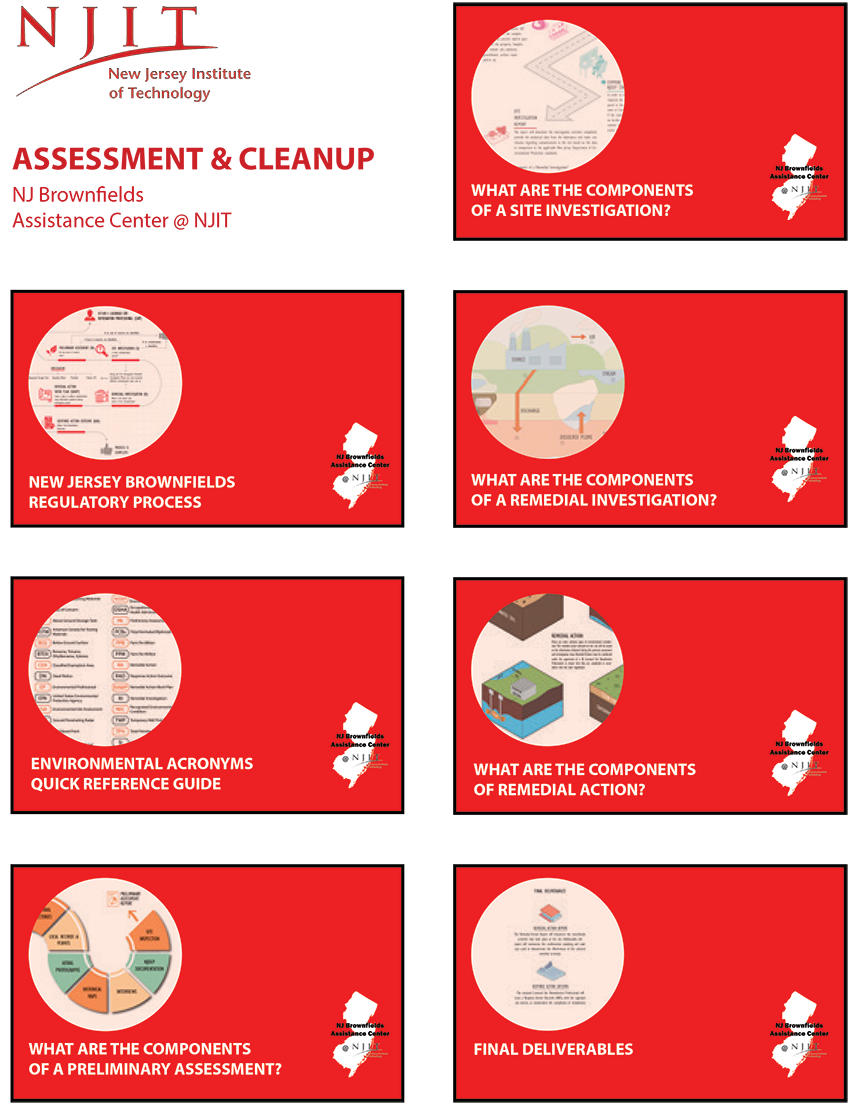
Brownfield Assessment & Cleanup
Environmental assessment and cleanup activities can begin after the community and lead organization has conducted their planning exercises to identify the assets and needs within the community and a brownfield site is selected for redevelopment.
First Step – Conduct a Preliminary Assessment
The first step in the environmental assessment process is to have a Licensed Site Remediation Professional (LSRP) perform a Preliminary Assessment (PA). PA’s benefit communities by:
- Mitigating Risk – The community is able to see what possible contamination may have occurred at the site based on past ownership and documents that explain details of past operations.
- Liability Protection – The community also receives protections from the federal government if the PA is performed within 180 days before buying the site. However, the state does not provide liability protection when owners are willing to purchase a site that is contaminated.
Gaining site access is much easier if the previous property owner agrees to allow access or the site is owned by a municipality (through tax foreclosure or any other involuntary reason). If it is owned by a private property owner who does not allow site access, it can be more complex.
A PA will typically consist of performing the following tasks:
- Identifying the property description
- Identifying the building description
- Identify historical land use
- Conduct Interviews & Site observation summary
- Conduct mapping reviews
- Review government database search & previous reports
- Identify current and historical site ownership and operations
- Review tax records, deeds, and chain of title
- Summarize findings and recommendations
Second Step – Conduct Site Investigation
Additionally, if there are any areas of concern (AOC) that are identified during the Preliminary Assessment, then it would be prudent to hire an LSRP to conduct a Site Investigation (SI). The Site Investigation will identify the presence and/or absence of environmental contaminants on the property through sampling. Depending on the results of the samples, the Site Investigation should outline additional site investigation needs and potential remedial solutions that may be required to clean up the property if contaminants are found. If no contaminants are found, a Remedial Investigation is not necessary.
A Site Investigation will typically consist of performing the following tasks:
- GPR Survey
- Groundwater sampling
- Soil sampling
Third Step – Conduct a Remedial Investigation
If contaminants are present, a Remedial Investigation (RI) takes the information from a Site Investigation and determines the extent of contamination of the property. This investigation is more detailed and gives a more accurate depiction of the environmental issues on the property, and is necessary to uncover additional information prior to cleanup work beginning.
A Remedial Investigation may consist of performing the following tests and tasks:
- Groundwater testing
- Subsurface soil assessment
- Sediment testing
- Assessing pathways of contaminants in soil and groundwater
- Creating a Remedial Action Work Plan (RAWP)
A Remedial Investigation should allow parties involved to develop a plan of remediation, which needs to have the approval of local, state and federal environmental agencies. It will also detail a full scope of options for all parties and time and costs involved with cleanup.
Fourth Step – Cleanup
After all the assessments and investigations have been conducted and the RAWP is created and a remedial activity has been selected then it is time to implement the cleanup. Ideally, the cleanup will factor in the reuse, extent of the contamination, and all applicable state cleanup standards.
What Is A Brownfield?
A brownfield is defined under NJ state law (N.J.S.A. 58:10B-23.d) as "any former or current commercial or industrial site that is currently vacant or underutilized and on which there has been, or there is suspected to have been, a discharge of a contaminant." While this is the definition recognized in state legislation, there are many variations on this definition. Generally, brownfields are properties that are abandoned or underutilized because of either real or perceived contamination.
Brownfield Assistance / Success Stories
10,000
estimated brownfield sites in NJ
2021
CIANJ Environmental Leadership Award Recipient
Related News and Events
Latest News & Events
Thanks to our affiliate members for their support!

NJ Brownfields Assistance Center @ NJIT
njbrownfields@NJIT.edu
Federal Brownfield Contacts
USEPA Region 2
The Brownfields and Land Revitalization Programs in Region 2 assist communities, local governments, property owners and developers in restoring land and other natural resources into sustainable community assets that maximize beneficial economic, ecological, and social uses to ensure protection of human health and the environment in New Jersey. The USEPA administers Brownfield grant funding on a yearly basis.
Terry Wesley
Brownfield Program Section Chief
EPA-Region 2
Wesley.Terry@epa.gov
212-637-5027
Schenine Mitchell
Brownfields Coordinator
Mitchell.Schenine@epa.gov
212-637-3283
USDA - New Jersey Office
Rural Development Business Programs
Maryann Tancredi,
Business Programs Director
maryann.tancredi@usda.gov
856-787-7752
Janis Rega
Area Director
Janis.rega@usda.gov
908-441-7523
Rural Development Community Facilities Program
Christine Schmelzle
Community Programs Director
christine.schmelzle@usda.gov
856-787-7751
Janis Rega
Area Director
Janis.rega@usda.gov
908-441-7523
State Brownfield Contacts
New Jersey Economic Development Authority (NJEDA)
If you are a business in need of financing to grow in New Jersey, a not-for-profit organization seeking capital to expand community services, a municipality looking to attract a major corporation within your boundaries, or a developer requiring funds for a major redevelopment project, the New Jersey Economic Development Authority (NJEDA) is ready to put its resources to work for you.
Elizabeth Limbrick, PG, LSRP
Senior Brownfields Advisor, Policy & Communications
Elimbrick@njeda.com
862-872-3334
New Jersey Department of Environmental Protection (NJDEP)
The Office of Brownfield Reuse (OBR) was created to serve as the focal point for the Department’s brownfield program. OBR is charged with coordinating remediation and reuse efforts at specific brownfield sites and piloting innovative approaches to expedite the revitalization process.
Frank McLaughlin
State of New Jersey Department of Environmental Protection
Frank.McLaughlin@dep.nj.gov
609-633-8227
Community Collaborative Initiative (CCI)
The Community Collaborative Initiative (CCI) works closely with diverse partners in urban communities to support their vision for revitalization and growth. NJDEP’s traditional role is evolving through the use of a single DEP point-of-contact to leverage resources and expertise that brings innovative solutions to complex environmental challenges. The Community Collaborative Initiative operates in twelve New Jersey municipalities which are Camden, Trenton, Perth Amboy, Bayonne, Bridgeton, Jersey City, Millville, Newark, Paterson, Paulsboro, Salem, and Vineland.
Vince Caliguire
CCI Lead
Vincent.Caliguire@dep.nj.gov
609-508-2085
Community Engagement
Community Engagement is a strategic process with the specific purpose of working with identified groups of people, whether they are connected by geographic location, special interest, or affiliation to address issues affecting their well-being. It is a process of fostering and sustaining trust and an opportunity for diverse perspectives. The goals of engaging the community are to achieve long-term and sustainable outcomes, relationships, and decision-making.
Engaging the community in the planning for and redevelopment of brownfield sites is the single most critical element of a successful brownfield project. Educating the community on brownfields, garnering their input as to community needs and how those needs may be met through the redevelopment of the site(s), and soliciting their input regarding the ultimate redevelopment of the site(s) should all be part of the community engagement process.
There is no one-size-fits-all approach to engaging the community. As every community is different and every community’s needs are different, it is critical that you construct a thoughtful and thorough plan before you engage. The answers to the following questions will help inform your community engagement plan:
Who is the community?
Remember that communities are diverse in terms of age, gender, ethnicity, socio-economics, mobility, and education attainment. Careful consideration in identifying ‘the community’ is needed.
Why are you engaging the community?
What is the purpose? What do you hope to achieve? Answers to these questions will help you determine the methods you select for engaging your community.
How will you engage the community?
There are many different tools and techniques available. Explore the variety and research how other communities have successfully used these methods, then select the methods appropriate for your community.
When will you engage the community?
It is recommended that you engage your community throughout the entire brownfields process (from planning through redevelopment).
What will you do with the results of the engagement?
How will you incorporate community feedback into the planning for and redevelopment of your brownfield site(s)? Feedback to the community and follow-through are critical!
Successful community engagement empowers citizens, elevates community spirit, strengthens social inclusion, and contributes to meaningful change.