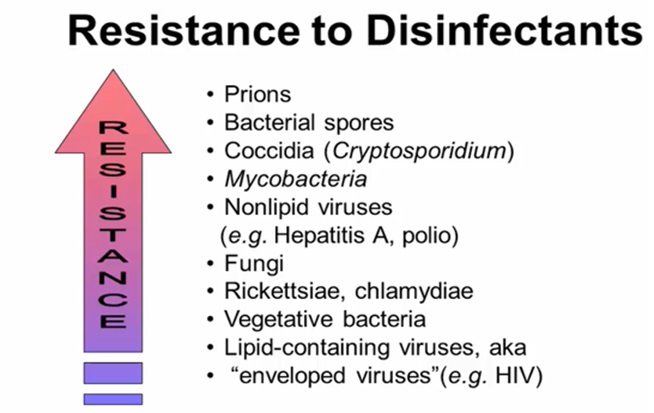
There are multiple factors that influences pathogen efficacy such as organic load, laboratory environment (temperature, humidity, surfaces), disinfectant concentration, contact time, and the stability of the disinfectant during storage. In general, prions are the most resistant to disinfectants and "enveloped viruses" are the least resistant.
Alcohols
Alcohols are broad spectrum antimicrobial agents that damage microorganisms by denaturing proteins. Typically, ethanol (C₂H₆O) and isopropanol (C3H8O ) are used, and mainly for surface disinfection. Alcohols require some degree of water to be effective. Therefore, higher concentrations (>90%) may be less effective. Alcohols’ efficacy can also be limited by the organic load and its evaporation rate.
- 70% concentration is most effective
- Effective against vegetative bacteria
- -Kills most bacteria within 5 minutes of exposure
- -Longer contact times for fungi and mycobacteria
- -Ineffective against spores
- Limited in virucidal activity
- Variable effect against non-enveloped viruses
- Ethanol (70-80%) is considered virucidal.
- Isopropanol is not effective against non-enveloped viruses.
- Longer contact times are difficult to achieve due to evaporation
Chlorine Compounds
Chlorine compounds are broad spectrum antimicrobial agents that are inexpensive and fast-acting. They are effective against bacteria, enveloped and non-enveloped viruses, mycobacteria and fungi. At elevated concentrations, chlorine compounds can be sporicidal, but very corrosive and irritating to users. The most prevalent chlorine is an aqueous solution of 5.25% sodium hypochlorite (household bleach).
- Factors that impact effectiveness
- Quality of water used to make solution can make chlorine less effective.
- Solutions are light sensitive.
- High temperatures cause chlorine to decompose faster.
- Organic matter can neutralize chlorine.
- Not suitable for autoclaving.
- Corrosive to metal
- Never mix with acids or ammonia which can release a toxic chlorine gas.
