Technical Support Associate
Where do majors work?
Common Job Titles
Top Employers
Meet some students
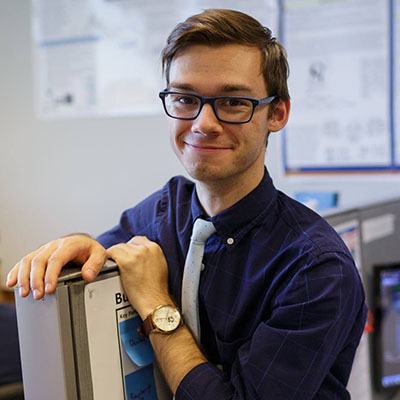
I chose to complete my master's in BME at NJIT because I could design a program that fit my needs.
John Vito d'Antonio-Bertagnoli
Class of 2017
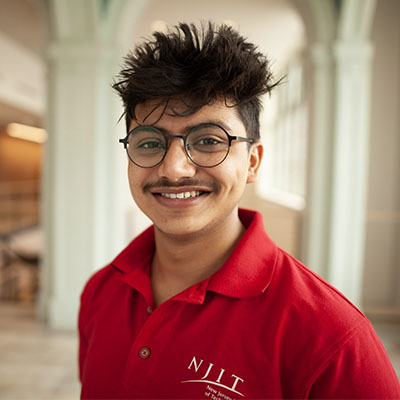
I was able to get research experience during my freshmen year, which is really cool.
Madhusan Duwadi
Class of 2022

I’m really grateful to the Honors College for giving me the chance to do research.
Margaret Christian
Class of 2014
Want more? Visit us at an on-campus event.
Learn MoreRelated Majors
Summary
The BME program prepares students for productive careers related broadly to biomedical engineering. It is anticipated that BME graduates will embark upon diverse career paths: serve the medical device, pharmaceutical, and biotechnology industries, and use their education in a variety of related endeavors including medicine, dentistry, law, business, government, and other engineering and scientific fields.
While working within their selected career path, we expect that our alumni will demonstrate the following traits:
- BME alumni are integrators and we expect our graduates to integrate their fundamental knowledge of sciences, mathematics, liberal arts, and engineering analysis into actions that address and solve a wide range of problems, especially those related to medicine and biology.
- BME alumni continue their professional growth, and we expect our graduates to advance their skills through professional growth and development opportunities provided by participation in a professional society, continuing education, or graduate study in engineering or other professional fields.
- BME alumni are engaged in service, and we expect our graduates to engage in service to their chosen professional societies as well as their local, national or global communities.
At graduation, undergraduate Biomedical Engineering students will have spent considerable time in labs learning research techniques, strategy and execution working alongside renowned experts in many facets of this diverse discipline. They will gain fundamental knowledge about the Biomedical Engineer’s approach to understanding and solving healthcare challenges. Along with expertise in a specialty, we expect all of our students to demonstrate that they possess the following knowledge and skill sets:
- An ability to apply knowledge of mathematics, science, and engineering
- An ability to design and conduct experiments, as well as to analyze and interpret data
- An ability to design a system, component, or process to meet desired needs within realistic constraints in these frameworks: economic, environmental, social, political, ethical, health and safety, manufacturability and sustainability
- An ability to function on multidisciplinary teams
- An ability to identify, formulate and solve engineering problems
- An understanding of professional and ethical responsibility
- An ability to communicate effectively
- The broad education necessary to understand the impact of engineering solutions in a global, economic, environmental and societal context
- A recognition of the need for, and an ability to engage in, life-long learning
- A knowledge of contemporary issues
- An ability to use the techniques, skills and modern engineering tools necessary for engineering practice.
|
134-136
|
Required Credits |
Accelerated Option
View the Curriculum
Course listing and prerequisitesCore Faculty
Adamovich, Sergei
Professor
View ProfileBiswal, Bharat
Distinguished Professor
View ProfileChandra, Namas
View ProfileAlvarez, Tara
Distinguished Professor
View Profile
Electrical Engineering
Biology